
Asteroid City Review: Wes Anderson on Film, on Television, and on Stage
I knew I was walking into a director’s world that would be thorough in all ways...

Director: Wes Anderson
Run Time: 1 hour 44 mins
When it comes to Wes Anderson, I’m a long-time fan, first-time reviewer. Though many of my friends adore his work, I’ve only managed to see scenes of The Royal Tenenbaums Fantastic Mr. Fox, The Life Aquatic with Steve Zissou, and Isle of Dogs. I knew I was walking into a director’s world that would be thorough in all ways, so I made sure to not watch any trailers, and I suggest you avoid promotions as well.
Aside from the synopsis, I didn’t know the premise for the movie and that made it so much more of an experience for me: “The itinerary of a Junior Stargazer/Space Cadet convention (organized to bring together students and parents from across the country for fellowship and scholarly competition) is spectacularly disrupted by world-changing events.”
Asteroid City is a fictional town in the American West. A group of 5 teenage stargazers are welcomed to the town to receive awards for their work in the field. While the students get to know one another, their parents and guardians interact with one another as well as the locals.
The film uses a layered framing device that’s meta at the same time. Asteroid City is actually a stage production being filmed for the first time as a TV special in front of a live audience, with a host, for broadcast. The behind-the-scenes action and development of the original play get caught in the film process as well. The film is spectacularly quiet.
I love the enigma of Asteroid City, particularly its existence as a sort of Rubik's cube. Figuring out how the layers of the film work is akin to solving the cube in that nothing is necessarily lost or gained, but there’s joy in the process. I live for a solid, metatextual piece that’s aware of itself without fully breaking the 4th wall, so Asteroid City had me hooked from the moment our Host, Bryan Cranston, appeared on screen and set. I don’t mind that the film didn’t leave me with an explosive reflection or cognition on life because I left the screening with a smolder of something. I had something to chew on.
With little history available about the past of our characters and only presumptions available about their future, the present will fascinate you. Jason Schwartzman plays Augie Steenbeck, the main character and father figure. Scarlett Johansson plays Midge Campbell, a mother and celebrity figure. Tom Hanks plays Stanley Zak, the grandfather figure and father of Augie’s deceased wife.
Jeffrey Wright plays General Gibson, the military representative, while Edward Norton plays Conrad Earp, the playwright and artist archetype. Woodrow, Augie’s son, is played by Jake Ryan. The cast is deep, as is typical for Anderson’s films, and they’re confident. The film is confident in itself too, yet still open to interpretation. I’m still searching for comparables, but for now, I’ll settle on Nolan’s work in that audiences are free to debate their interpretations, but that debate only strengthens the work. It doesn’t diminish it at all. Nothing is lost. Only gained.
The confidence of the cast, including Steve Carell as a motel manager and Rupert Friend and Seu Jorge as cowboys, made it hard to find a favorite, but my breakouts are Schwartzman and Ryan; this father-son duo maintain longing, awe, introspection, grief, and a spellbound air throughout the entire film, keying in on Anderson’s deadpan and stoic approach. The two play off one another so well that I sincerely believe they must be related in another life.
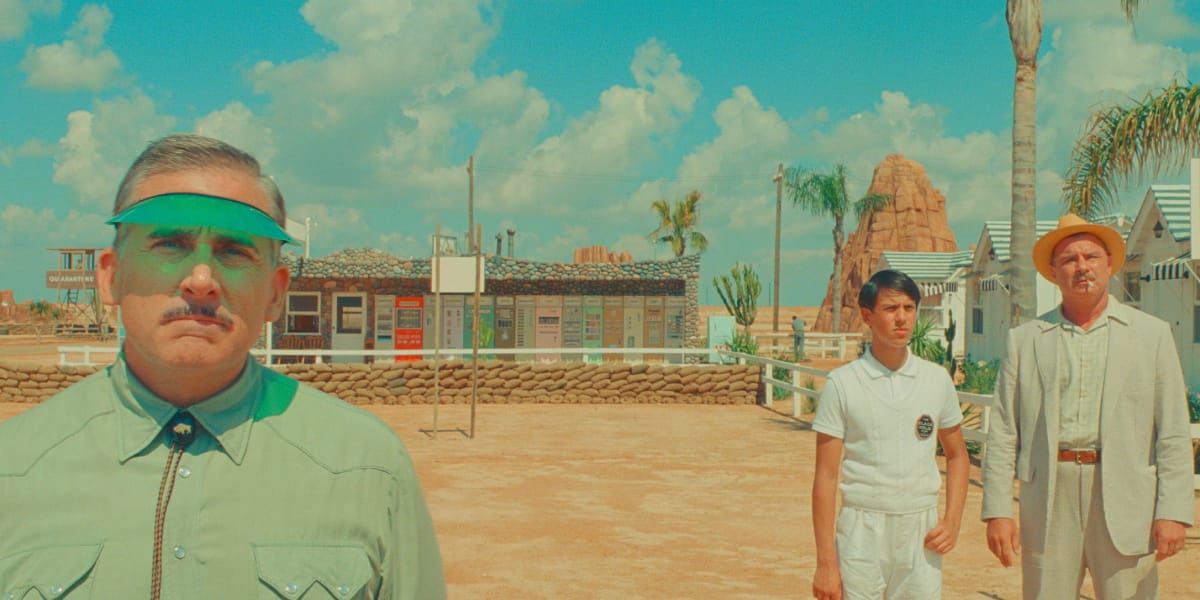
If you too struggle to find a favorite among the cast, then consider another option: the set and production design. Yes, Anderson leans heavily on symmetry and pastel, which among other methods TikTok should apologize for attempting to simplify, but the beauty is how this style works so well regardless of the lens employed. Whether on a constructed stage, television broadcast, or film set, the commitment to the mid-1900s is thorough and functions so well, audiences will believe this fictional space actually exists.
When you leave Asteroid City, you’ll have more than you started with, but it’ll be difficult to measure or qualify. Asteroid City is a solid 4 out of 5.